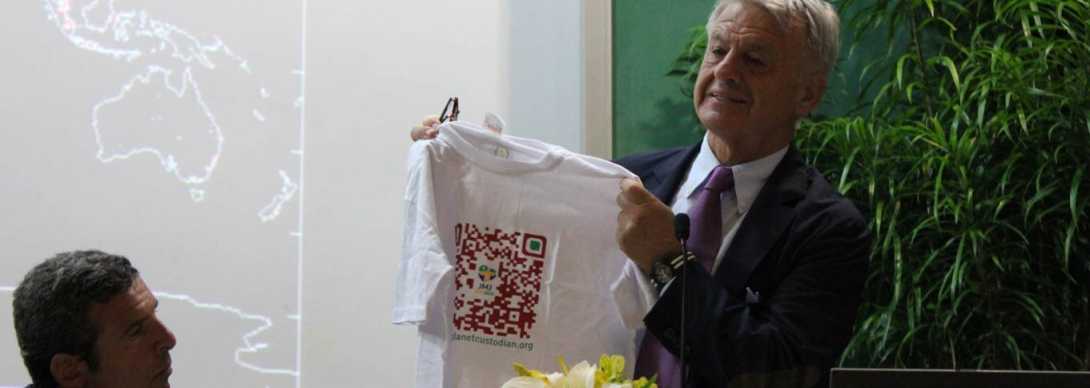
Hundreds of thousands of young people from around the world gathered in the rain on Rio de Janeiro's famous Copacabana beach to celebrate World Youth Day on Tuesday, July 23rd.

Hundreds of thousands of young people from around the world gathered in the rain on Rio de Janeiro's famous Copacabana beach to celebrate World Youth Day on Tuesday, July 23rd.

The Connect4Climate team is honored to welcome humanitarian and international music star Rocky Dawuni as a judge for the Voices4Climate photo/video/music video/podcast competition.
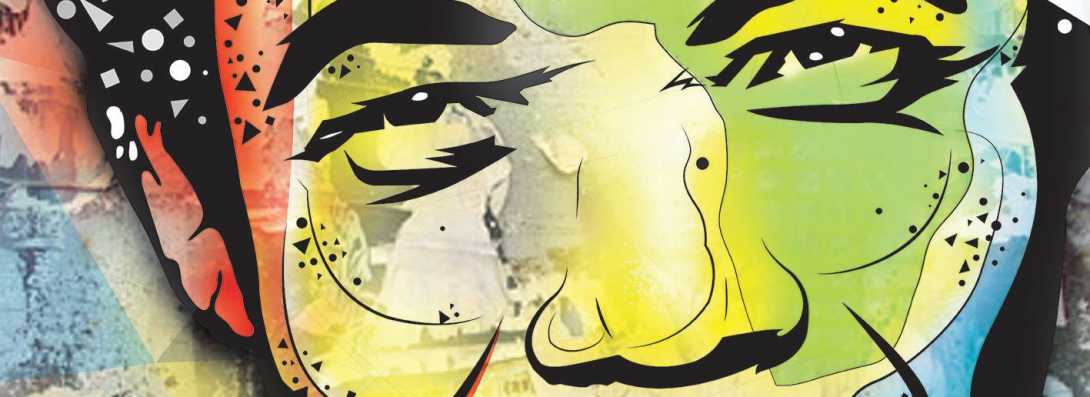
.@NelsonMandela Inspiring #COP20 Leadership "Make Our World a Sustainable Source" -
<p>Gratefulness for the beauty of nature is not something that occurred to the late, great Nelson Mandela in just the final years of his life. During his 27 years in jail on Robben Island, he fought to have a garden installed on the roof of his prison, where he and his fellow inmates could grow vegetables for their meals.<o:p></o:p></p>
<p>"To plant a seed, watch it grow, to tend it and then harvest it, offered a simple but enduring satisfaction," he recalled in <a href="http://en.wikipedia.org/wiki/Long_Walk_to_Freedom" target="_blank">Long Walk to Freedom</a>. "The sense of being the custodian of this small patch of earth offered a small taste of freedom." We have to remember that Nelson Mandela placed climate justice amongst his priorities for all people. He immediately knew that climate change would have devastating consequences on the most vulnerable citizens of our global society.<o:p></o:p></p>
<p>Nelson Mandela, who died last year at age 95, left two legacies for climate advocates — the necessity of endless and incremental campaigning and the value of divestment.<o:p></o:p></p>
<p>In his 1995 autobiography, he wrote, “There were many dark moments when my faith in humanity was sorely tested, but I would not and could not give myself up to despair. That way lays defeat and death.” One would ask: what would Madiba do for the climate change movement now, if he were still around? Most likely his immediate response would have been: “It always seems impossible until it’s done.” Perhaps he would have even added: “ Change never comes without a fight.”<o:p></o:p></p>
<p>Mandela’s wisdom on climate change is still relevant, he could teach and promote the greatest of values like no other. <a href="http://www.un.org/sg/statements/index.asp?nid=7347" target="_blank">Secretary-General of the United Nations, Ban Ki Moon</a> has noted: “Nelson Mandela was more than one of the greatest leaders of our time, he was one of the greatest teachers, and he taught by example.” Climate change is the “next great moral” issue, in a similar way as apartheid once was.<o:p></o:p></p>
<p>The difficulties Mandela had to overcome for South Africa are similar to the difficulties that lie before mankind, making his contribution invaluable in our search for solution to tackle climate change.<o:p></o:p></p>
<p>Nelson Mandela’s vision of a “rainbow egalitarian society” is identical to the environmentalists’ dream of a habitable planet Earth and healthy environment for present and future generations. Mandela was like a man awoke too early in the darkness, while the others were all still asleep. Nelson Mandela’s spirit will inspire generations to come to follow his path and build a better future.<o:p></o:p></p>
<blockquote>
<p><strong>“Sometimes it falls upon a generation to be great, you can be that generation” - Nelson Mandela</strong><o:p></o:p></p>
</blockquote>
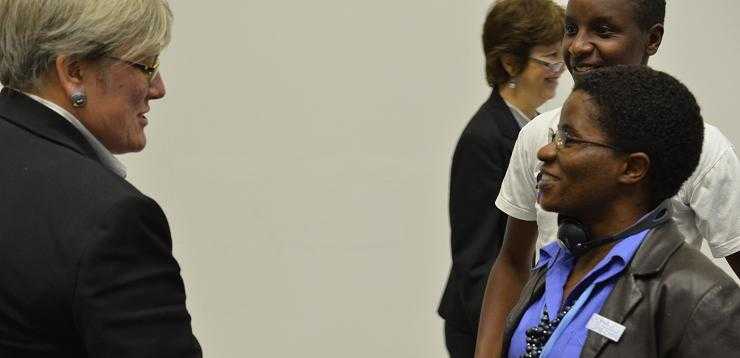
Last September, TerrAfrica and Connect4Climate launched the Voices4Climate competition in collaboration with MTV to invite young people to submit photos, videos, music videos, and podcasts that tell powerful climate chan
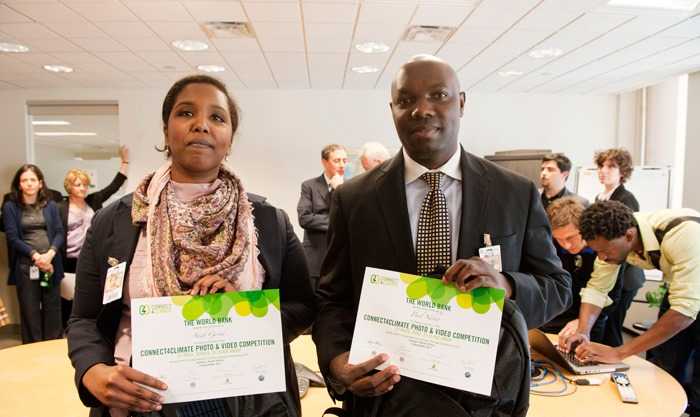
Following the awards ceremonies we have held at various World Bank offices in Africa, including Kenya and Egypt, the Connect4Climate team was thrilled to honor US-based Paul Ndiho and Anab Garab at the World Bank offices in Washington, DC.

The Connect4Climate team is honored to welcome accomplished singer, author, fashion designer, and entrepreneur Cedella Marley as a judge of the Voices4Climate photo/video/music video/podcast competition.

Connect4Climate was proud to support the Match for Expo, a game that pitted the best present and recent-past players in a historic football match held in Milan this week.
<p style="text-align: center;"><img alt="" src="/sites/default/files/images/legacy/zanetti-MatchForExpo.jpg" style="width: 1000px; height: 442px;" /></p>
<p style="text-align: center;"><span style="font-size: 11px; line-height: 20.0063px; text-align: center;">Match for Expo. Photo credit: Zanetti & Friends / TVN Media Group</span></p>
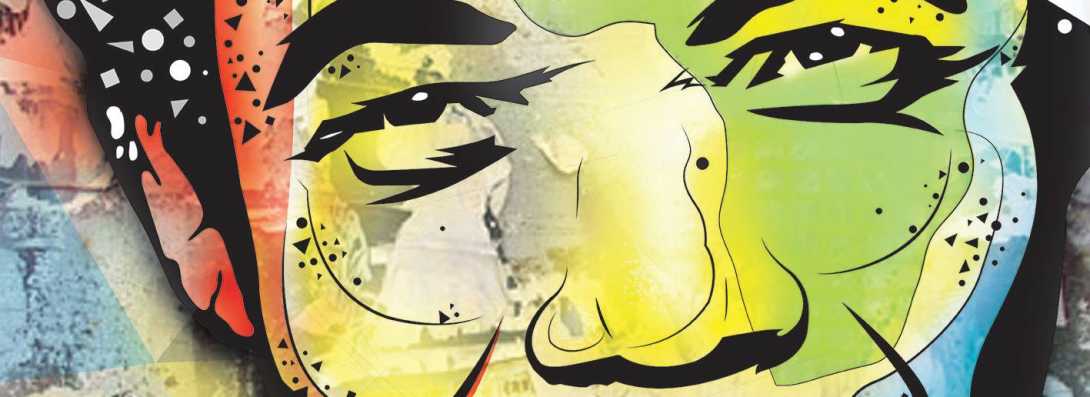
It’s hard to believe that the world has been without Nelson Mandela for more than a year. We remember him for his leadership, his wisdom and his ability to bring people together.
Every month, around five million people migrate to a city somewhere in a developing country in hope of improving their lives and the lives of their children.
<p>The <a href="http://www.worldbank.org/en/news/press-release/2013/09/25/world-bank-in…; target="_blank">Low-Carbon Livable Cities Initiative</a> (<a href="http://connect4climate.org/infographics/building-low-carbon-cities" target="_blank">see the infographic here</a>) supports the cities of the developing world in their efforts to set themselves on a low-carbon and resilient development path. Leveraging the expertise of its many partners, the World Bank Group has designed a series of planning and financing tools that can be tailored to cities’ needs and help them tap their full emissions reduction potential.<o:p></o:p></p>
<p>Applying a climate lens to cities’ development plans means that, energy savings resulting in lower carbon emissions will free up budget for other sustainable investments, resilient infrastructure will withstand the forces of nature, and citizens will have cleaner air to breathe.<o:p></o:p></p>
<p>By reaching 300 of the largest developing country cities, the Initiative has the potential to improve the lives of over 700 million people in the cities it will help, and billions globally as emissions are reduced.</p>
<p style="text-align: center;"><a href="https://staging.connect4climate.org/infographics/building-low-carbon-ci… style="font-size:10.5pt;font-family:"Helvetica",sans-serif;color:#787878"><o:p></o:p></span></a><a href="https://staging.connect4climate.org/infographics/building-low-carbon-ci…; target="_blank"><img alt="" src="/sites/default/files/images/Cities_infographic.png" style="width: 700px; height: 352px;" /></a></p>
<p>When it comes to planning, the first step is to understand the problem at hand.<o:p></o:p></p>
<p>A recent analysis found that only about <a href="http://www.worldbank.org/en/news/press-release/2013/09/25/world-bank-in…; target="_blank">20 percent of the world’s 150 largest cities</a> have even the basic analytics needed for low-carbon planning. Through the City Climate Planner Certification Program the Initiative seeks to address this gap by building a talent pool that will contribute to expanding the quality and capacity of urban climate planning.<o:p></o:p></p>
<p>The transformational potential of the Certification Program lies in its promise to generate and embed within cities the human resource base to drive evidence-based climate action. City-level greenhouse gas inventories will provide municipal governments with a snapshot of their emissions profile and enable them to identify the mix of policies and investments that will help them achieve their full emissions reduction potential.<o:p></o:p></p>
<p>Smart planning is only one part of the solution. Many of the world’s municipalities are struggling to keep up with the infrastructure and service needs of their growing cities. On top of that, many cities in the developing world cannot access capital markets to source the necessary financing for sustainable infrastructure.<o:p></o:p></p>
<p>As cities grow, municipal governments need to broaden and deepen sources of financing, moving beyond traditional public funding to access much larger private pools of savings, particularly in domestic capital markets. An analysis of the 500 largest cities in developing countries shows that only a small percentage are deemed creditworthy – about 4 percent in international markets and less than 20 percent in local markets.<o:p></o:p></p>
<p>The first step to get finance flowing is to make municipalities more attractive to private investors and help them access markets. The Initiative offers a unique City Creditworthiness Academy to help municipal governments set themselves on the path to access local capital markets directly. It took Lima about five years and $700,000 in technical assistance to achieve investment grade.<o:p></o:p></p>
<p>Its first sub-sovereign debt financing transactions dates back to 2010, when the municipal government was able to raise $90 million from a local commercial bank, which was invested to finance the city’s bus-rapid transit (BRT) system called the "Metropolitano". After first obtaining a domestic rating, Lima then went on to obtain an international credit rating a few years later.<o:p></o:p></p>
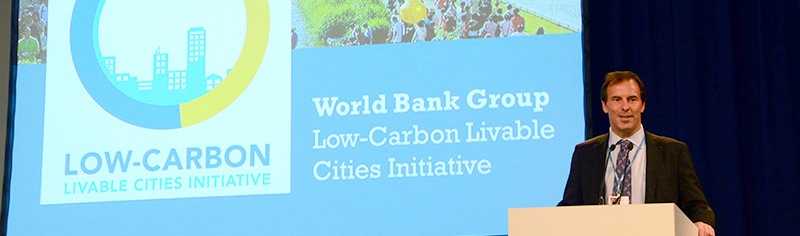
<p>Considering the important role the urban environment plays in climate change, a “new urban world will define development success towards a low-carbon world,” according to James Close, Director of Climate Change at the World Bank Group. He elaborated at the <a href="https://unfccc.int/bodies/awg/items/8170.php" target="_blank">Technical Expert Meeting on Urban Environment</a> at the UNFCCC Bonn meetings on 10 June that low-carbon livable development plans for cities was the most sensible way forward.<o:p></o:p></p>
<p>He emphasized three major action points that need to be supported. First, we need to “change the tone of the conversation and get public-private-partnerships going to leverage finance”. Then we need to “think in a transformative manner about city development plans to get the adaptation strategy right,” and finally cities should start “thinking about a carbon price for all their investment planning.”</p>
<p style="text-align: center;"><img alt="" src="/sites/default/files/images/James_Close-small.jpg" style="width: 800px; height: 530px;" /></p>
<p><o:p></o:p></p>
Cittadinanzattiva (Active Citizenship), an Italian nonprofit devoted to civic participation, organized the "SpreK.O.
<p>The day before the festival, Connect4Climate organized a <a href="http://connect4climate.org/learn/article/innovative-solutions-to-waste-…; target="_blank">live web discussion</a> on waste management issues on <a href="http://www.theguardian.com/global-development-professionals-network/glo…; target="_blank">The Guardian’s Global Development Professionals Network</a>. The two-hour Q&A session featured a panel of 10 experts, including John Morton, Senior Urban Environment Specialist at the World Bank, and Delphine Arri, Environment Specialist at the International Finance Corporation.<o:p></o:p></p>
<p>The online discussion drew a significant audience, with members posting 178 comments on a variety of solutions to waste. John Morton recognized the importance of monetary incentives to motivate people to improve recycling. David Jones from the Plastic Oceans Foundation added two great examples:<o:p></o:p></p>
<p>“In Dahab in the Sinai, no tin is on the ground because the locals understand their value and recycle them… In <a href="http://www.theguardian.com/environment/2011/mar/18/recycling-waste" target="_blank">Germany</a>, every PET bottle is worth 40 cents for recycling.”<o:p></o:p></p>
<p>David Jones also raised the point that plastic production accounts for 88% of the world’s oil reserves, and about 150 million tonnes of plastic waste is thrown away annually after just one use. In his opinion, to tackle waste effectively our throwaway lifestyle would have to change. John Morton highlighted effective examples for reducing consumption, including a <a href="http://www.treehugger.com/corporate-responsibility/ban-against-plastic-…; target="_blank">plastic bag ban</a> in Latin America, or the <a href="http://www.usatoday.com/story/news/nation/2013/12/21/polystyrene-foam-b…; target="_blank">Styrofoam ban</a> in the U.S.<o:p></o:p></p>
<p>Highlights from the online discussion were used to fuel panel discussions at Cittadinanza in Festa. The festival’s core theme, knocking out waste, was used as a thread to explore a variety of sustainability challenges.<span style="font-size:10.5pt;font-family:"Helvetica",sans-serif;color:#787878"><o:p></o:p></span></p>
<p>A panel discussion on May 2nd, highlighted that the average Italian throws away 76 kg of edible food each year, 42% of it at home. At the same time, food production is being constrained by rapid urbanization: over the past 3 years 720 km² of Italian land has been paved over, equivalent to the surface area of Milan, Bologna, Florence, Naples and Palermo combined. The social cost of the carbon dioxide emissions generated by this construction has been estimated at 130 million Euros, and it was estimated to have cost the Italian economy 90 million Euros in imported food that could no longer be grown locally.</p>
<p style="text-align: center;"><img alt="" src="/sites/default/files/images/10258890_793254317366561_553764725461794792_o.jpg" style="width: 697px; height: 390px;" /></p>
<p align="center" style="margin: 0in 0in 15pt; text-align: center; background-image: initial; background-attachment: initial; background-size: initial; background-origin: initial; background-clip: initial; background-position: initial; background-repeat: initial;"><span style="font-size:9px;"><span style="font-family: Helvetica, sans-serif; color: rgb(120, 120, 120);">Riccardo Valentini opens the panel discussion on knocking out food waste. </span></span><o:p></o:p></p>
<p>On the food waste panel Michele Bruni of Enterprise Projects Ventures, stressed the need for technology to overcome shrinking agricultural land. Beatrice Costa of Action Aid Italia highlighted the results achieved through pilot programs in schools, which teach youth to not to waste food. The Italian Minister of Health, Beatrice Lorenzin, emphasized the need to find uses for food that is still healthy but no longer meets retail standards.<o:p></o:p></p>
<p>Riccardo Valentini, a board member of the Intergovernmental Panel on Climate Change, highlighted the challenge of feeding 7 billion people, the current global population. He advocated including consumers in creating sustainable solutions<span style="font-family:"Helvetica",sans-serif;
color:#787878">.</span><span style="font-size:10.5pt;font-family:"Helvetica",sans-serif;
color:#787878"><o:p></o:p></span></p>
<p>A May 3rd panel discussion focused on Environmental Waste. Marco Frey, President of Cittandinzattiva opened the panel and emphasized the need for citizens to own the waste challenge, as businesses are responding to changing consumer demands.<o:p></o:p></p>
<p>Every day, the world’s population generates enough waste to fill over fourteen large soccer stadiums from top to bottom, <a href="http://documents.worldbank.org/curated/en/2012/03/16537275/waste-global…; target="_blank">more than 3.5 million tonnes</a>. Walid Norris from Connect4Climate highlighted that if waste management trends continue, landfilled food waste is predicted to increase world methane emissions from <a href="http://www.waste-management-world.com/articles/print/volume-11/issue-2/…; target="_blank">31 million to 43 million tonnes</a>, a significant jump for the potent greenhouse gas.<o:p></o:p></p>
<p>Specific solutions discussed included innovation in consumer products, citing companies like Fater achieving zero waste in their production process and designing fully recyclable products. Similarly Giorgio Arienti highlighted that citizens can now take simple steps to recycle almost every electronic product they buy.<o:p></o:p></p>
<p>At the event <a href="http://www.rokiatraore.net/" target="_blank">Rokia Traoré</a>, recognized as one of Africa’s most innovative singers and songwriters, was formally recognized as a new Connect4Climate Global Leader for her commitment and dedication to supporting climate change action around the world. She performed selections from her newest album, “<a href="http://www.nonesuch.com/journal/rokia-traore-beautiful-africa-out-now-2…; target="_blank">Beautiful Africa.</a>”</p>
<p style="text-align: center;"><img alt="" src="/sites/default/files/images/Rokia-Global_Leader_Award-small.jpg" style="width: 851px; height: 315px;" /></p>
<p style="text-align: center;"><span style="font-size:9px;">Antonio Guadioso, Walid Norris, Rokia Traoré, and Alessandro Cusso on stage as Rokia receives the Global Leader award. Photo: Luca Liccione / Cittadinanzattiva</span><o:p></o:p></p>
<p>Other events at the festival included book presentations, an electric bicycle tour, theatrical performances and music concerts. As part of Cittadinanzattiva’s campaign SpreK.O, or Knocking out Waste, there were also workshops and labs aimed at teaching citizens, especially youth and children, about how to reduce food waste, solid waste and waste in the healthcare system.<o:p></o:p></p>
<p><a href="http://connect4climate.org/event/knocking-out-waste-cittadinanza-festa&…; target="_blank">SpreK.O. - Cittadinanza in Festa 2014</a> is an encouraging example of citizens coming together to take ownership of the climate challenge and address it with creative solutions<span style="font-family:"Helvetica",sans-serif;
color:#787878">.</span><span style="font-size:10.5pt;font-family:"Helvetica",sans-serif;color:#787878"><o:p></o:p></span></p>
<p><o:p></o:p></p>