

Some insights about the Uniting4Climate competition
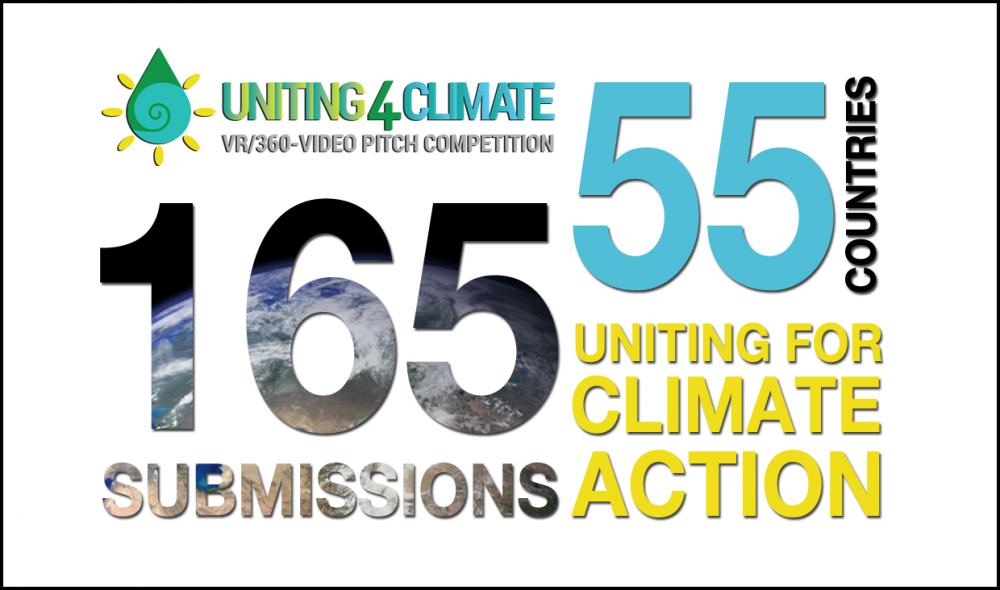
Out of the 165 video pitch submissions, 40% were sent in by female participants and 60% by male participants. Average age is 35 years old. Regarding world regions, Connect4Climate received the most submissions from Europe and Central Asia (27%), then followed by Latin America and Caribbean (24%). Third on the list is Sub-Saharan Africa with a total of 24 submissions (15%) followed by North America (14%), East Asia and Pacific (8%), South Asia (8%), and MENA region (4%). The data makes it clear climate change affects everyone regardless gender, age, social status, or region.
Meet the finalists
Connect4Climate is delighted to unveil the Uniting4Climate VR/360-video Pitch Competition finalists:
 Ancient Trees
[video:https://youtu.be/HVh8bmGJ4_M]
VR/360 video proposal: Immersive 360 documentaries have a unique ability to transport an audience and evoke emotion in a more profound way than any other medium.
Choices - Meet Your Footprint
[video:https://www.youtube.com/watch?v=8m4lRI3yjS8&feature=youtu.be]
VR/360 video proposal: Years ago, while visiting Copenhagen, I happened upon a gigantic 10m-wide balloon set up by an environmental group to show the actual volume of one ton of C02, the approximate GHG emissions created by one round-trip flight from Europe to the US.
Climate-VR
[video:https://www.youtube.com/watch?v=Sca3-3_pwhM&feature=youtu.be]
VR/360 video proposal: When designing this proposal, I continually asked myself: How can we use virtual-reality (VR) to communicate the urgency of climate change as effectively as possible? How can we ensure that by using VR, we are creating lasting engagement with climate change and motivating action? How can we promote positive social values, whilst ‘Uniting4Climate’?
My name is Niall and for this competition I have developed ‘Climate-VR’ – a new 360/VR experience that pushes the boundaries of climate change engagement to a new level.
I am a Ph.D. researcher, specialising in the psychology of communicating climate change. My research is all about understanding how we can boost public engagement with climate change by understanding narratives, images and psychological principles.
What I have come to realise is that we have often failed to communicate climate change in ways that resonate with different types of audiences. Communicators typically rely on ineffective messages, framing climate change as an environmental disaster, very distant from everyday concerns (think polar bears and melting ice caps). These types of messages might work for some people, but generally they are easily deflected and can decrease motivation to act.
This is why I am proposing Climate-VR – an experience of climate change, unlike any other. Climate-VR is unique in that it is personalised to each viewer, offering a powerful, beautiful and immersive experience of climate change, based around real-life aspirations and the power of human stories.
Through four different stories, Climate VR is tailored to the ‘values’ of each viewer. It connects climate change with what we really care about. To promote positive actions, viewers are prompted to pledge three simple behaviours to mitigate climate change. Afterwards, further engagement is fostered though discussion and educational activities.
Climate-VR can be developed quickly and simply, according to whatever budget is possible. It is flexible, as it can be refined to more basic elements, or developed further, enhancing it’s capacity for tailoring and personalisation. I have also developed strategies for marketing, to ensure Climate-VR reaches a truly wide audience.
Furthermore, if produced, I will incorporate Climate-VR into my on-going research, in order to investigate its power to change actions and attitudes, through scientific testing.
Together, I believe this proposal offers a new, powerful approach to climate change communication, which could promote large-scale engagement with climate change.
I urge you to support Climate VR.
Eco-friendly habits: everyday, everyone
[video:https://www.youtube.com/watch?v=xgH2E2pFXLo&feature=youtu.be]
VR/360 video proposal: The world is facing a serious challenge in climate change. However, the drivers of climate change are extremely complex, and no single action or solution can resolve the issue.
Facing the Front LinesVR/360 video proposal: Through immersive cross-cultural storytelling, Facing the Front Lines will transport audiences around the world to spend a day in the life of local climate activists endeavoring to unite their communities for conservation and climate change adaptation.
Food Waste and Climate ChangeVR/360 video proposal: In a VR journey let’s follow the life of a “roll of bread”, from the day is baked to the day it is disposed.
Marine Conservation through Experiential Learning
[video:https://youtu.be/uwL8T_vy1UA]
VR/360 video proposal: Background: Environmental education is becoming increasingly crucial for changing a student’s commitment, motivation and behaviour towards becoming a partner in sustainable development. It is difficult to drive change as students feel that environmental issues are not relevant to their immediate lives. Students have rarely experienced nature, out in the wild, so how can they be expected to feel for and work towards its betterment. Schools do attempt to introduce the relevancy of environmental issues in different ways but most of these issues are taught in class rooms so they fail miserably. Moreover, awareness alone, does not lead to any change in behavior for environmental conservation. This will only happen if children experience nature. Experiential learning through the use of ‘place based’ strategies help children bond with nature and it is the most effective way to pursue environmental education. While the strategy of experiential learning has been proven to be extremely successful especially to ensure that students work towards the healing of the planet, it proves difficult, especially in India. Taking students on field trips or even outdoors is extremely difficult due to logistical, safety and cost related issues. Especially in marine related learnings, underwater ecosystems can never be experienced through mere visits to the beach. Experiential learning is completely missing in marine biology and marine conservation. Therefore, there is a total apathy and neglect in protecting marine ecosystems. Through this project we envisage an innovative approach to bridge the gap in experiential learning for marine related experiences.
North Pole - The Last Frontier of Climate Change OasisVR/360 video proposal: SUMMARY For us, this is something we feel passionate about. Aside from raising awareness of the freshwater resources, we think it’s crucial to introduce practical ways to save water. Optimally each presented solution would be linked to external sites to encourage to act today.
Off-Grid Integrated FarmingVR/360 video proposal: Off-Grid Integrated Farming Unit
The Great Polish ForestVR/360 video proposal: You don’t have to go far to realize the impacts of climate change. We read about sea level rise from Bangladesh to Brazil, with difficulties of understanding the impact for us at home. Home for me is Europe - home to beautiful fields, lands and striking forests.
The Thin Green Line Two Wheels into the Future
[video:https://youtu.be/Iv7eC85bwpA]
Uniting for Climate Change SolutionsVR/360 video proposal: The video will open up on a 360 drone flight over devastated areas of the Caribbean, ground zero for the recent effects of climate change. The viewer is taken to a rural neighborhood where a home is encountered, destroyed by the hurricane.
X-Ray Fashion VRVR/360 video proposal: Our world’s resources cannot keep up with consumers’ demands, amongst others, garment production for the fashion industry. Being inspired by the documentary ‘The True Cost’, we wish to create a VR installation that takes the audience on a journey through the lifespan of garment production, consumption and disposal with the devastating consequences. This is an x-ray investigation of the fashion industry.