This year's Guadalajara International Film Festival, unfolding across the city of Guadalajara, Mexico from March 8 through March 15, will bring cutting-edge visionary cinema to venues including libraries, museums and cultural centers.
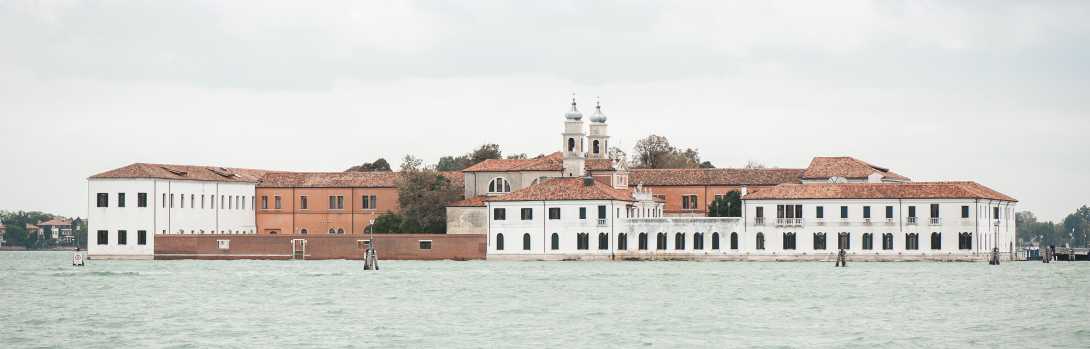
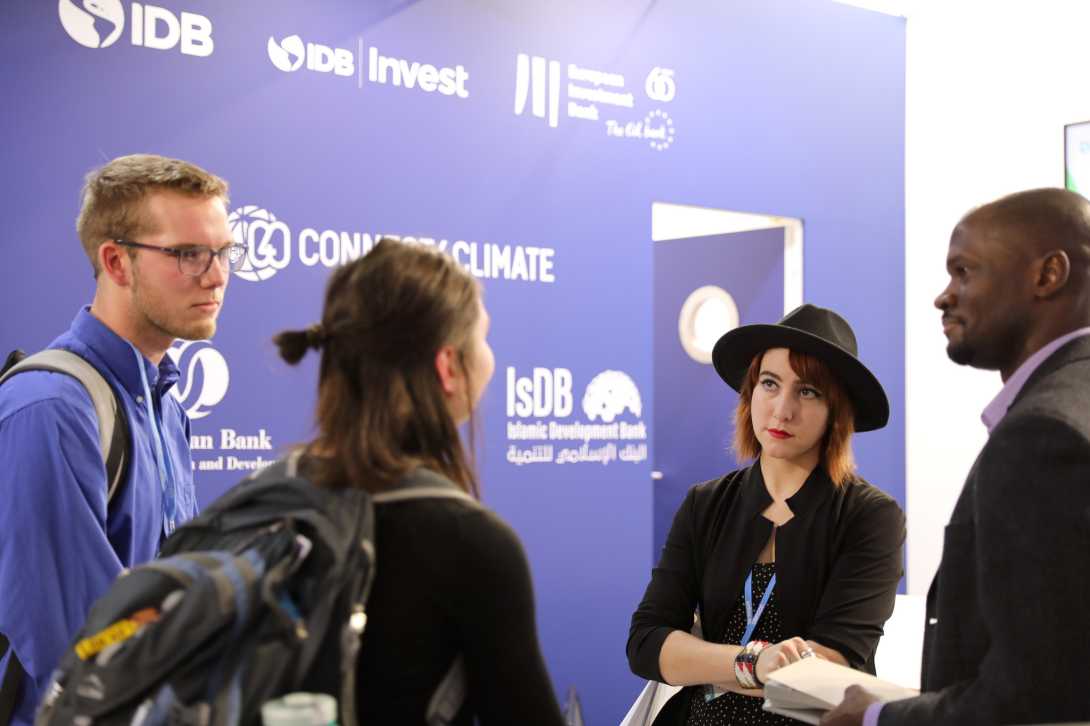
Venice International University’s fifth Sustainability Symposium got underway today, bringing together dozens of influential voices from academia, government, NGOs and the private sector for an honest conversation about the challenges of achieving widespread decarbonization and ways in which to overcome them.
The introductory remarks of University president Umberto Vattani and Alcantara chairman Andrea Boragno framed the symposium in terms of the question “How?”, setting a clear solutions-oriented tone that would continue throughout the day. Vattani called the event “a great opportunity to understand how we can enhance synergies among ourselves on pressing issues,” while Boragno hammered home the urgency demanded by the threat of climate change.
"We have to undertake more #climateaction and urgency. In this room all of us is aware of a number of evidences. We are missing the 2ºC set by #Paris and global common approach" Andrea Boragno – Chairman and CEO of Alcantara S.p.A. @AlcantaraSpa #5Symposium #ClimateHow @univiu pic.twitter.com/Mlzh7Pxc5q
— Connect4Climate (@Connect4Climate) February 7, 2019
The first major session of the day, which garnered wide attention on social media, was titled “How to Decarbonize: What’s Happening Now, and What’s Next on the Agenda?” and provided an informative overview of current approaches to reducing carbon footprints and innovative strategies for further mitigating them down the line.
Speaking on the alarming recently published report from the Intergovernmental Panel on Climate Change (IPCC), Daniel Klingenfeld of the Potsdam Institute for Climate Impact Research stressed that the panel’s findings should not be regarded as mere numerical data, but as evidence of the very human cost of international inaction on climate issues. “We need to be carbon neutral, globally, by the middle of the century,” he said, rallying the diverse audience in a call to action. “We need to do more to avoid the risk.”
"“The IPCC report does not talk only about numbers. It talks about people" - Daniel Klingenfeld – Head of the Directors’ Staff at the Potsdam Institute for Climate Impact Research @PIK_Climate #5Symposium #ClimateHow @univiu @AlcantaraSpa pic.twitter.com/4iKFC9iMvt
— Connect4Climate (@Connect4Climate) February 7, 2019
Bjørn Kj. Haugland, executive vice president at DNV GL Group, followed Klingenfeld’s overview of the IPCC report with a look at the evolving energy landscape and ways to accelerate the move toward renewable resources. He found cause for optimism in the rapid growth of the electric auto industry, and called on audience members to continue to push for wind power and other renewables in their respective fields, emphasizing the necessity of energy efficiency moving forward.
Timothy Nixon, managing editor of Thomson Reuters sustainability, rounded out Session 1 with a talk on the need for transparency in industry as decarbonization efforts advance. Nixon focused on the importance of cementing rapports with business leaders, noting that the key to success is “convincing businesses that it is in their own interest to move on a transparency basis and towards decarbonization.”
“How are businesses going to decarbonize? This question is absolutely crucial. We can’t achieve the target without them on board” - Timothy Nixon – Managing Editor of Thomson Reuters Sustainability @Reuters#5Symposium #ClimateHow @univiu @AlcantaraSpa pic.twitter.com/3XNaMrQ3ob
— Connect4Climate (@Connect4Climate) February 7, 2019
Session 2, titled “How Corporations Can Ramp Up Climate Action,” kicked off promptly at the end of the first. The first speaker, United Nations Global Compact senior manager Heidi Huusko, nodded to the courage of unflinching youth leader Greta Thunberg as she began her presentation, and called on corporations to answer the demands of the youth. At the same time, Huusko stressed the importance of meeting companies halfway and recognizing the strictures of the business world. “We try to have ‘commitment areas’ where we push companies to do a little bit more,” she said.
Huusko’s presentation was followed by one from Equnior ASA senior vice president Bjørn Sverdrup, who homed in on the oil and gas sectors of the global economy. He noted that shifting the energy market toward sustainability is a two-way street: “This is a journey with both producers and consumers of energy. Citizens need to take more responsibility and businesses need to innovate to make the transition happen.”
"We try to have commitment areas where we push companies to do a little bit more - you need consistency in your own future perception of the company: where do you want to go and how transparent you want to be" - @HeidiHuusko #5Symposium #ClimateHow @univiu @AlcantaraSpa pic.twitter.com/Fe4ZdkXoKp
— Connect4Climate (@Connect4Climate) February 7, 2019
Yin Bo of the Global Energy Interconnection Development and Cooperation Organization and Ralf Pfitzner of Volkswagen rounded out the first half of Session 2. Bo communicated the urgency of implementing sustainable energy through very concrete examples, noting that the entire city of Venice—the venue for the conference—would soon be underwater absent a global commitment to change, and citing his own experience with Beijing air quality as evidence of the potential of “hydropower, wind and solar energy” to make a real difference.
Pfitzner, for his part, laid out Volkswagen-specific plans to cut back on carbon emissions moving forward, providing an illustration of the sort of corporate responsibility demanded by the previous speakers.
"The air condition in #Beijing has improved - how? We have developed hydropower, wind and solar energy" - Yin Bo - Deputy Director of Europe Office, GEIDCO: “Global Energy Interconnection: Electrification and Decarbonization”#5Symposium #ClimateHow @univiu @AlcantaraSpa pic.twitter.com/rs6wxDH1Jb
— Connect4Climate (@Connect4Climate) February 7, 2019
Session 2 picked back up at 11:30 AM following a coffee recess as Fair Fashion Founder Cara Smyth took the stage to speak on decarbonization in the fashion sector. Smyth said that the key was persuading a core group of brands to embrace more sustainable methods such that their example would lead others in the industry to follow suit to stay competitive and au courant. “The more companies are motivated, the better,” she summarized.
Up next was Paul Jefferiss, head of policy at British Petroleum, a company keen on turning over a new leaf and rebranding itself in the wake of Deepwater Horizon. Jefferiss called attention to BP’s support of the UK’s electric car industry, and expressed a desire for communion among “policymakers, corporations and the society as a whole” in the months and years to come.
"The more companies are motivated, the better - from investors to CEOs, to the supply chains" - Cara Smyth – Vice President @gcnyc_news #5Symposium #ClimateHow #Fashion4Climate @univiu @AlcantaraSpa pic.twitter.com/bbsP3TpDvu
— Connect4Climate (@Connect4Climate) February 7, 2019
Following Jefferiss was Henrik O. Madsen, chairman of the Norwegian Research Council. Madsen framed his talk on ocean life and the food industry by posing a simple question. “Fish farming is growing, and the question is: Can it be sustainable?” He highlighted the roles certain species of seaweed can play in the sustainable production of food fish, among other strategies.
Jérôme Schmitt of the Oil and Gas Climate Initiative offered further thoughts on getting oil and gas companies on board with climate action. He noted the importance of forging productive two-sided relationships with companies, rather than simply making demands: “If we want to trigger the solutions, we need to be able to provide the best solutions.”
"When you lead alone, you do not lead too long. You need to lead together, to have visions: be part of the problem, be part of the solution" - Jérôme Schmitt, Executive Committee Chairman @OGCInews - Oil and Gas Climate Initiative#5Symposium #ClimateHow @univiu @AlcantaraSpa pic.twitter.com/y5rhZB1Fpc
— Connect4Climate (@Connect4Climate) February 7, 2019
Session 2 concluded with a talk from Herman Penng, Audi’s head of e-fuels project management. Pengg inspected the vital relationship between legislation and business practices, and pushed for more effective legislation as a means of catalyzing sustainability drives in business. “In 2050 we will have very efficient electric cars,” Penng said, “but that is not enough: legislation should be efficient.”
A lunch break led into the 2:30 PM commencement of the third session. Session 3, titled “How Finance Can Help Win the Fight Against Climate Change,” and Session 4, “How Policymakers, Citizens and Consumers Can Drive Decarbonization,” featured six speakers each, and provided a balanced look at sustainability through economic and sociopolitical lenses.
"The lifecycle is crucial: it monitors all the emissions, analyzing all the environmental impact of technology" - Hermann Pengg – Head of Project Management e-fuels at @Audi#5Symposium #ClimateHow @univiu @AlcantaraSpa
— Connect4Climate (@Connect4Climate) February 7, 2019
Professor Gustav Martinsson of RMIT University encapsulated well the role of finance in effecting change when he noted that “Above everything, climate change is a structural issue, and finance is the resource needed to efficiently allocate capital.” Rebecca Thomas, an associate at the investment management firm Arabesque, followed this with a call for data transparency and the standardization of data across companies.
Herman Bril, director of the Office of Investment Management at the United Nations, laid out ways in which asset owners could contribute to the blossoming of new technologies and help drive climate action, while Notre Dame professor Leo Burke described how climate-conscious investors could pave the way for robust carbon pricing legislation. Sagarika Chatterjee of Public Radio International echoed this call for investor action, saying that “Investors really need to step up to face the challenge ahead.”
Rebecca Thomas, Associate at Arabesque introduces S-Ray tool & explains how to apply it to the #climatechange challenge:
— Connect4Climate (@Connect4Climate) February 7, 2019
- data transparency
- accurate, consistent and comparable data
- simplifying the complexity of climate science#5Symposium #ClimateHow @univiu @AlcantaraSpa pic.twitter.com/2gs5bhQrGP
Arabesque chairman George Kell rounded out the finance talks by exhorting the public and private spheres to work together on climate change: “Public and private interest often collide, but unfortunately, collaboration is not always there. We need to optimize this relation.”
The final session of the day began with talks from KR Foundation chairman Connie Hedegaard and Global Renewable Independent Power Supplier CEO Alexander Voigt, who discussed the roles of policymakers in bringing about results on climate.
Now is the time to show we can make bold steps! We need new regulations for transports, #agriculture, #energy, .... to restructure everything. To show the solutions we want to see, we need political leadership now more than ever!
— Connect4Climate (@Connect4Climate) February 7, 2019
Connie Hedegaard @KR_Foundation #5Symposium pic.twitter.com/9j5YsVCHev
“We need new regulations for transports, agriculture, energy… to restructure everything,” said Hedegaard. “We need political leadership now more than ever!”
Voigt agreed, and emphasized the part of the public—particularly the young public—in motivating climate legislation. “We should get young people to engage on a local/regional level and catalyze their energy into something positive,” he said. Jessica Cheam, managing editor at Eco-Business, substantiated this theme of youth power by sharing anecdotes of her own experience engaging and inspiring young climate activists in Singapore.
.@giuliacamillabr highlights @Connect4Climate’s efforts on advancing sustainable fashion through the power of VR and the creativity of young filmmakers to communicate the importance of making fashion sustainable at #5Symposium #ClimateHow in #Venice. #fashion4climate pic.twitter.com/OQorHE6lmt
— Connect4Climate (@Connect4Climate) February 7, 2019
Up next was Giulia Braga, program director of Connect4Climate, World Bank Group. Braga agreed wholeheartedly with the prior speakers’ emphasis on youth, and used it to segue into the official launch of a new large-scale Fashion4Climate campaign, which will have its own website and center around the touring virtual reality experience X-Ray Fashion. Created by MANND and directed by fashion photographer Francesco Carrozzini, X-Ray Fashion offers an immersive presentation of climate crises in the fashion industry via cutting-edge technology, and is sure to get young people invested and active in the fight for the welfare of our planet.
The final speaker of the day was Princeton’s distinguished ecology and evolutionary biology professor Simon A. Levin, who offered an apt synopsis of the issues at the heart of the symposium: “The challenge is to understand how to change people’s attitudes, and how to create momentum for the private sector and governments to accept that decarbonization is crucial.”
Completing the case-study presentations was Ralf Pfitzner, Global Head of Sustainability at Volkswagan AG, who launched the second day of the 5th International Symposium for Sustainability with a deep dive into VW's approach to decarbonization. With ambitions plans in place Pfitzner emphasized: " We believe that Volkswagen is capable of bringing e-mobility to the people."
"BY 2022 we will be able to save 1.5M tons of CO2, corresponding to emissions of 870.000 cars per year" - @ralf_pfitzner, Volkswagen#5Symposium #ClimateHow @AlcantaraSpa @univiu pic.twitter.com/MlRg1avjDO
— Connect4Climate (@Connect4Climate) February 8, 2019
The symposium's second day focused the discussion towards identifying tangible outcomes to follow through on "How to Engage Society and Deploy Decarbonization" with a series of panel discussions. Max Edkins from ConnectClimate, World Bank Group, was Master of Ceremony for the event and concluded while all participants gathered for a group photo: "We have all come togther here to build a future that is beneficial for our children. We have heard it from teh private sector, from the financiers, from the media, we have heard it from each and everyone of you, how inspired you are."
Some of the most forceful and moving voices heard at the UN Climate Change Conference in Katowice, Poland belonged to the world’s youth, who are stepping up like never before to galvanize action against global warming and get the international community back on track to meet the goals laid out in the Paris Agreement of 2016.
As part of the Talanoa Dialogue, a Fijian boy named Timoci Naulusala and a Polish girl named Hanna Wojdowska took the podium together to deliver a moving Call for Action. Alternating in their speech, the two young delegates advocated for a renewed focus on climate both within and without the political realm, holding governments accountable while also reminding everyday people and independent organizations of their own power to make a difference.
The young speakers did not shy away from the responsibilities of their own demographic. “We call on the youth of the world to mobilize at a larger scale,” Wojdowska asserted, “to ensure that the future is secure.” “We call upon everyone to act with agency and recognize that we are in a race against time,” Naulusala said.
In the first week of COP24, an entire day, the Young and Future Generations Day, was set aside for the sharing of young voices and young ideas for a sustainable future. Consistent across the various youth delegate presentations was a sense of resolve in the face of crisis, a bravery for which younger generations too rarely get credit. UN Youth Envoy Jayathma Wickramanayake emphasized that “Young people continue to fight, and there is a responsibility on the part of policymakers to [ensure] that young people can meaningfully and effectively participate in these discussions.”
The World Bank Group’s Connect4Climate program supported numerous activities at COP24 to bring youth messages to life, not least of all presenting sustainable T-shirts that read: “Youth Unstoppable Stepping Up Climate Action.” At the Joint MDB Pavilion, where Connect4Climate was broadcasting daily interviews on Facebook, a youth-focused discussion, “Connecting to Accelerate Climate Action: Youth Unstoppable,” brought youth climate leaders and the Fijian Climate Champion Minister Seruiratu together for a productive dialogue.
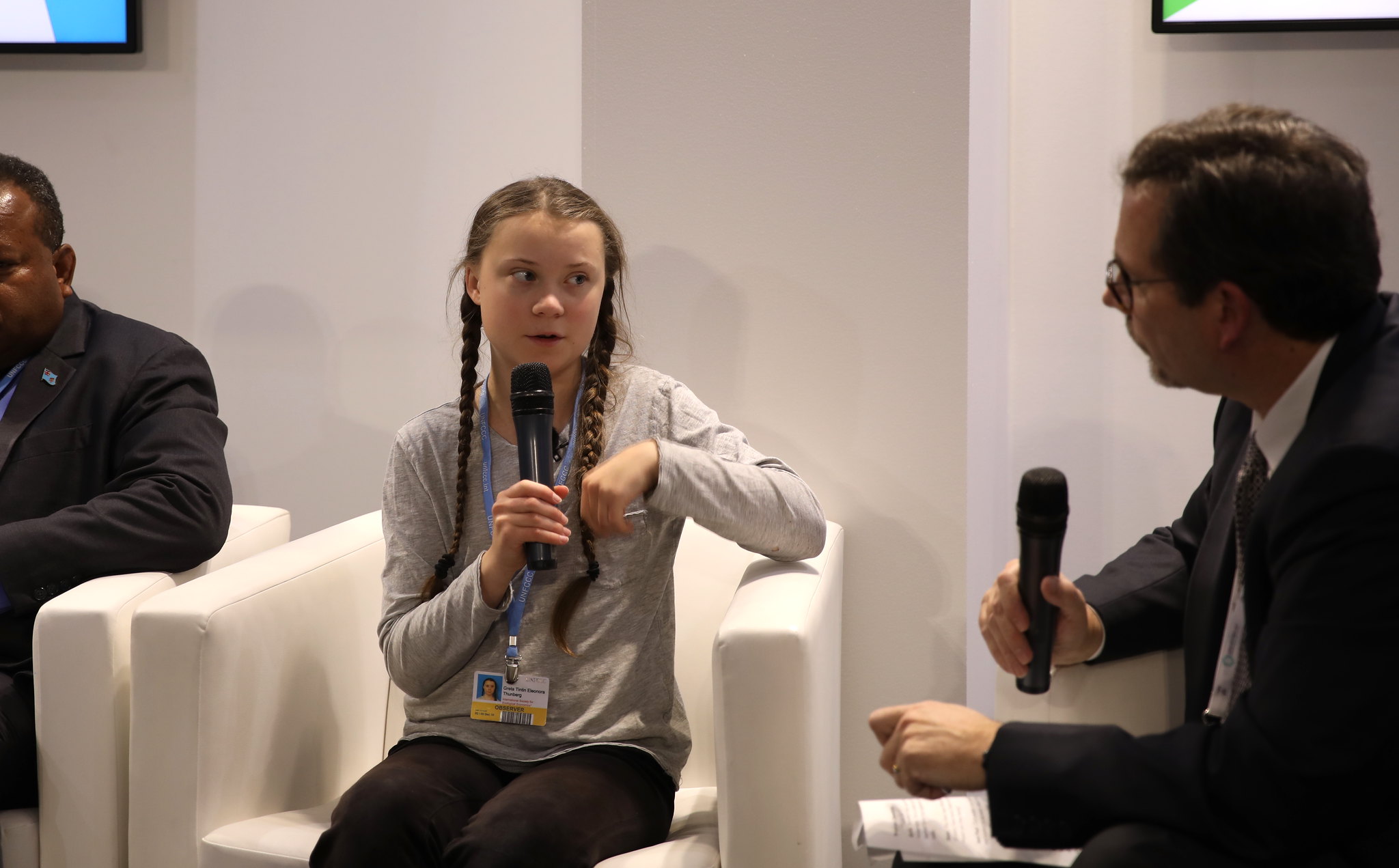
Greta Thunberg, the 15-year-old Swedish activist making global headlines for her unflinching stance on climate action, put it well: “You are never too small to change the world.”
The power of youth to band together to fend back climate change is the subject of the just-released documentary Youth Unstoppable, which presents youth climate movements from all across the globe in a vivid first-person perspective. The director of the film, Slater Jewell-Kemker, who also took part in Connect4Climate events, has received round accolades for her work.
Jewell-Kemker has become a role model for many in the youth climate movement. When introducing her film, she explained: “The reason why I took ten years to make the film was because young people have really come into their own, not only as storytellers, but as leaders. Young people have really risen to the challenge of recognizing that we are in a very particular moment as human beings, choosing what kind of world we want to live in, choosing what kind of people we want to be, in the face of a challenge that is essentially asking us how we want to survive. I find this incredibly exciting. We get to embrace each other and our relationship with the planet as a positive way to move forward.”
The Youth Unstoppable documentary trailer was presented at COP24 during the Youth Climate Action Awards Ceremony, and the film was screened in its entirety for large audiences in Katowice and Warsaw as part of the Climate Film Festival.
The impactful intersection of film, youth, and climate was further celebrated at COP24 with the announcement of the winners of the UNFCCC-led Global Youth Video Competition on Climate Change, which drew 300 heartfelt submissions from young people in more than 100 countries. Ferzina Banaji, Communications Lead for Climate Change at the World Bank Group, congratulated the creators of the video submissions: “It is inspiring to see what you are doing…and it should motivate all of us and inspire all of us to do more. It really demonstrates to us that climate action is unstoppable, and that youth are unstoppable.”
One of the winners was Andrea Sofia Rosales Vega, whose film centers on the Mexican youth group Eco Urban. Eco Urban recovers urban waste, sells it to green-minded recycling plants, and uses the proceeds to support the Economic Fund to Help Children’s Cancer. The other winner, Vikas Yadav, hails from rural India. In his movie, Yadav presents some of the ways in which Indian farmers are blending traditional and innovative agricultural techniques to minimize their greenhouse footprint while keeping true to their cultural heritage.
The most memorable youth moment of all was probably Greta Thunberg’s forceful speech in the COP24 plenary, where she told negotiators they are not mature enough and do not care enough: “You only speak of green eternal economic growth because you are too scared of being unpopular…You are not mature enough to tell it like is. Even that burden you leave to us children. But I don't care about being popular. I care about climate justice and the living planet…You say you love your children above all else, and yet you are stealing their future in front of their very eyes.”
“You only speak of green eternal growth because you are too scared of being unpopular...you are not mature enough to tell it like it is, even that burden you leave to us children...we cannot solve a crisis without treating it like a crisis.”@GretaThunberg at #COP24 pic.twitter.com/CIbcVLmthG— Connect4Climate (@Connect4Climate) December 12, 2018
The poise and commitment of young people all over the world taking a stand against climate change is enough to restore hope that, if we all band together, we really can get the job done and raise ambition, accelerating climate solutions and preventing our world from warming beyond 1.5 degrees Celsius. Thunberg embodied the conviction of the youth movement, declaring: “We have run out of excuses and we are running out of time. We have come here to let you know that change is coming, whether you like it or not.”
The Katowice Climate Conference, COP24, kicked off on December 3 with young people sharing their messages for the negotiations: “For me it’s hope that brings me here, hope for a better future.”
Leaders at the One Planet Summit in New York City call on the world to step up climate action.
"We must globally warm our hearts and change the climate of our souls."
"We have to dream big to scale up climate action. Do not give up. Step up."
Featuring:
At the end of last week, countries from all over the globe convened online in an unprecedented Virtual Climate Summit hosted by the Marshall Islands, leaders of the Climate Vulnerable Forum (CVF). The aim of the Summit—which aligned with the general mission of the CVF—was to raise awareness of the extent to which a couple degrees of global warming can devastate low-altitude and otherwise at-risk nations.
This “couple of degrees”—2 degrees Celsius—is not an arbitrary number, but rather the maximum net global warming (vis-à-vis preindustrial levels) permissible under the Paris Agreement of 2015. Participants in the Climate Vulnerable Forum stressed that even this 2-degree benchmark is not ambitious enough, and that any warming beyond 1.5 degrees will have deadly sea level and coral bleaching ramifications for low-lying and ocean-dependent communities.
The Virtual Climate Summit communicated these ideas through emotional documentaries, poems and call-to-action videos, live panel discussions and head of state video messages. And in addition to highlighting disproportionately affected nations, the Summit called attention to disproportionately affected strata of society, with a special focus on women and their tendency to bear the brunt of global warming effects.
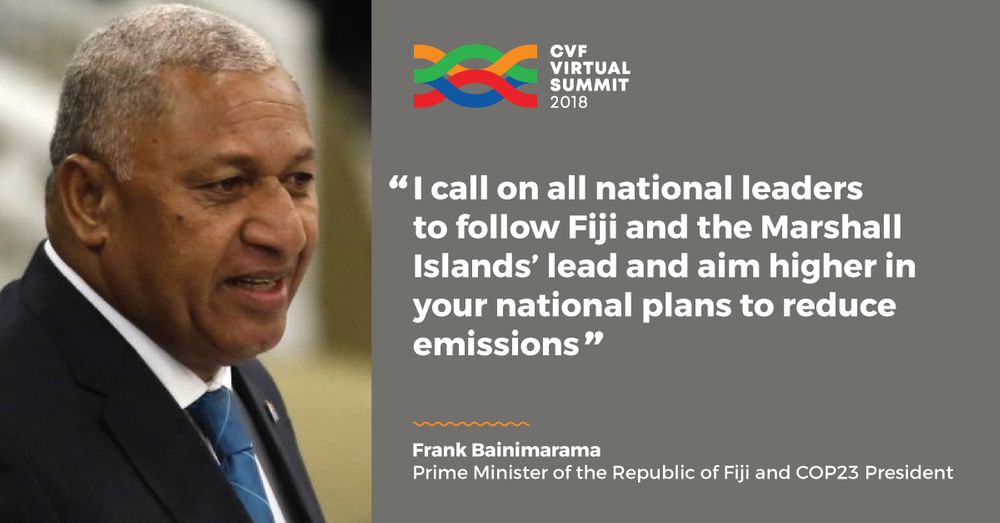
The Summit was not a pessimistic event but rather a realistic one, laying out the direness of the current situation and proactively offering solutions moving forward. The Marshall Islands set the tone of the Summit by stepping up and announcing concrete plans to raise climate ambition, declaring a commitment to 100% renewable energy and zero net emissions by 2050. Fiji joined the Marshall Islands by announcing an enhanced country climate action plan by next year and the Summit welcomed similar pledges from other endangered nations looking to set a sterling example for the rest of the world.

The official outcome of the Summit, particularly the “Jumemmej Declaration” will feed into the agreed mechanism to promote enhanced action by all nations party to the Paris Agreement dubbed the “Talanoa Dialogue” and sends a powerful call to arms to all leaders and non-state actors to enhance ambition by 2020. During the Summit Vanuatu also announced they may be seeking legal action against fossil fuel companies, taking the climate battle to the courts.
This event was the perfect way to set the stage for the 24th Conference of the Parties to the United Nations Framework Convention on Climate Change (COP24), which commences this week in Katowice, Poland and will continue through mid-December. COP24 is bringing together delegations to reassess the demands of global warming and to ramp up support for climate action in light of the IPCC Global Warming of 1.5 °C report, which emphasizes that current country climate action commitments are not enough. Building on the spirit of the Talanoa Dialogues, which personalized climate action through emotional story-telling and strive to raise ambition, COP24 aims to unpack a “Just Transition” for industries and economies by changing together.
The Virtual Climate Summit was an impactful reminder that even 2 degrees can be deadly, and yet the latest data suggest humanity is well on its way to 3 degrees of warming by the end of this century. COP24 will be an opportunity to take to heart the concerns laid out by the Vulnerable Climate Forum last week and redouble international commitments to the goals of the Paris Agreement.

With global carbon emissions at an all-time high in 2017 according to the WMO, leaders on climate agree that it’s now or never if we as a global community need to step up to have a shot at preventing global catastrophe. The IPCC tells us we have 12 years to make the global transition, decarbonize economies by 45% by 2030 from 2010 level, while also ensuring those most affected develop resilience to increasing climate impacts. Fortunately, it’s not all bad news. Entrepreneurs and investors in the private sector have shown an eagerness to contribute to the sustainable development sphere, and pricing carbon is seeing wider and wider adoption rates, while subsidies for fossil fuels are being removed.
The message of COP24 is not that we’re doing nothing right, but rather—in line with the arguments of the Virtual Climate Summit—that we need to seize on what we are doing right and do much more of it in the years to come. This will require novel strategies, a renewed sense of urgency, and wide-ranging teamwork, all of which are attainable if we keep our eyes on a brighter future.
Connect4Climate will be at COP24 from 3-14 December. Follow the daily Facebook live broadcasts from the Joint MDB Pavilion and look out for our call-to-action videos. Join the discussion, we are stepping up climate action.
Banner and thumbnail photo credits to the Climate Vulnerable Forum
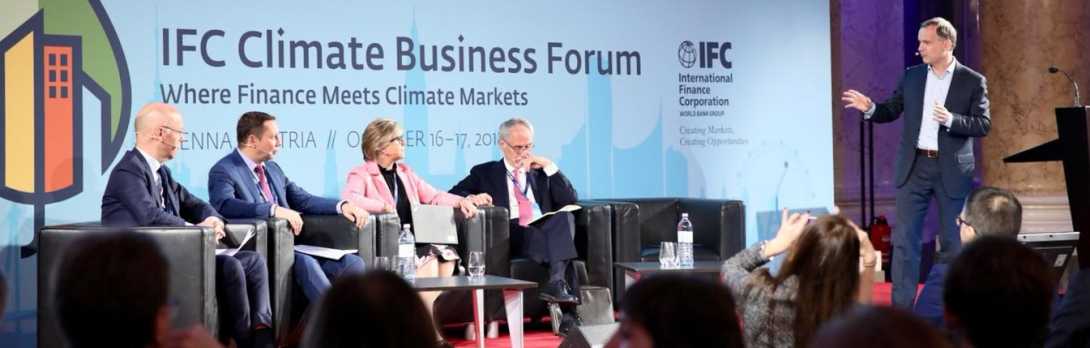
It's a wrap! At the 5th IFC Climate Business Forum 2018, participants emphasized why climate action is their business, how climate solutions are our business, and why everyone should be involved.
Check our photo album on Flickr
Thriving climate business models are those that are profitable, and impactful. Over US$ 1 trillion flows annually to climate business, ranging from smart cities, climate-smart agriculture, green finance, renewable energy, and green buildings. Climate business is the economic growth story of today — and tomorrow. Together we are building a decarbonized, resilient future.
"The need to invest to achieve the Sustainable Development Goals and the climate targets is huge, and so climate action is the right thing to do and the most exciting space to be, with new technologies and approaches."
Hans Peter Lankes, Vice President, IFC

Manu Jindal, Sustainability Project Manager, Nespresso, was at the 5th IFC Annual Climate Business Forum 2018 in Vienna to talk with Alzbeta Klein about how to green supply chains.
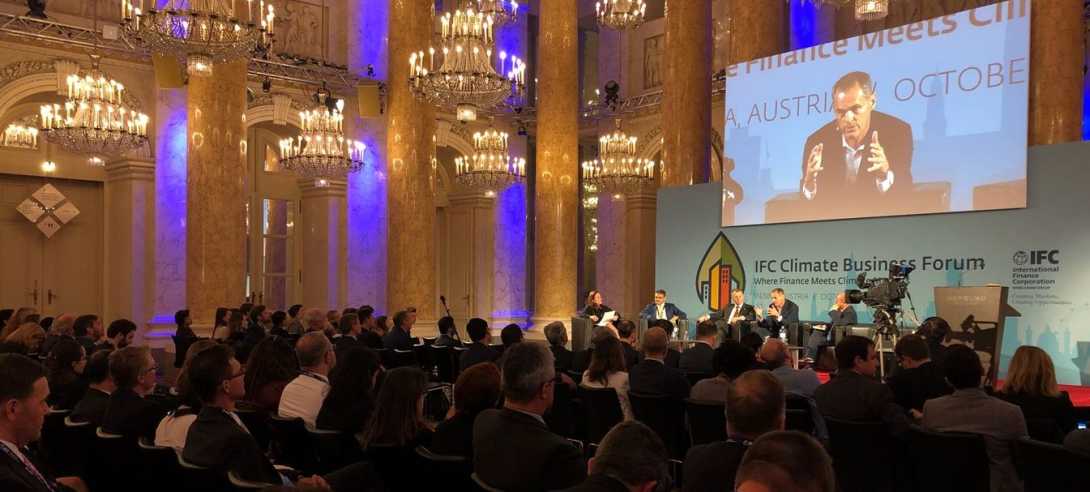

Jing Qian, Vice President, Jinko Power, with Shari Friedman at the IFC Climate Business Forum in Vienna to examine the future of solar energy.
Hans Peter Lankes, Vice President, IFC, with Giulia Braga to talk more about how to make Climate Business everybody’s business.
Sonia Lo, CEO, CropOne Holdings, talks with Giulia Braga about the future of farming.
At the 5th IFC Climate Business Forum in Vienna, Patricia Fuller, Climate Change Ambassador, Canada, talks with Alzbeta Klein to address Canada’s vision on how to accelerate climate action.
Banner and thumbnail photo credits to Kaia Rose / Connect4Climate
Michl Binderbauer, CEO, TAE Technologies, talks with Giulia Braga about Fusion Energy to Power Society at the IFC Climate Business Forum in Vienna.
Carlos Acosta, General Manager, Municipality of Barranquilla, Colombia, discusses with Alzbeta Klein about Cities Leading Climate Business at the IFC Climate Business Forum in Vienna.
At the IFC Climate Business Forum in Vienna, Antoine Predour, Head of Energy Debt Financing at responsAbility, speaks with Giulia Braga about Sustainable Investment in Growth Markets.
Kiril Shevchenko, CEO, Ukrgasbank, with Giulia Braga at the IFC Climate Business Forum in Vienna to talk more about the Role of Green Banking
Christopher Flensborg, Head of Climate & Sustainable Finance, SEB, with Giulia Braga discussing Climate Finance for Systemic Transformation at the IFC Climate Business Forum in Vienna.[video:https://youtu.be/zniDSDvrbfk]
Connect4Climate launched the Youth Unstoppable Call to Action Video at the United Nations on September 25, 2018.
Hosted by the World Bank Group and supported by Italy’s Ministry of the Environment and Energy Security and Germany’s Federal Ministry for Economic Cooperation and Development, Connect4Climate (C4C) is a global partnership for a livable planet that connects, creates, and communicates to build long-lasting change for future generations.