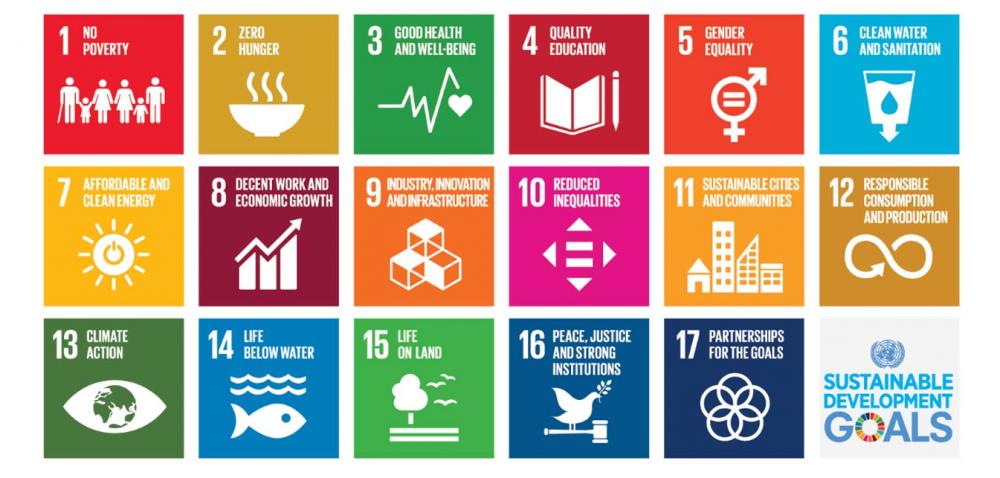
According to a new Global Opportunity Report from DNV GL, Sustainia and the United Nations Global Compact, renewed efforts are required to ensure four of the 17 UN Sustainable Development Goals do not miss their 2030 targets. The Global Goals addressed in the report are Goal 10: Reduced Inequalities, Goal 12: Responsible Consumption and Production, Goal 13: Climate Action and Goal 14: Life Below Water.

|
Ten new markets earmarked as opportunities to boost lagging Sustainable Development Goals
By
Highlights

Global Opportunity Report 2018 highlights four Sustainable Development Goals (Goal 10, 12, 13 and 14) that are likely to miss their 2030 targets
The report contains 10 new business opportunities which help these four goals progress
The new Global Opportunity Report and the 2015, 2016 and 2017 editions collectively demonstrate market potential in all 17 SDGs — including the ones we are least on track to reachConnect4Climate is joining the Twitter chat on February 1 at 4pm CET to discuss how business can help to reach the Global Goals.
(Høvik, Norway, February 1, 2018) — According to a new Global Opportunity Report from DNV GL, Sustainia and the United Nations Global Compact, renewed efforts are required to ensure four of the 17 UN Sustainable Development Goals do not miss their 2030 targets. The Global Goals addressed in the report are Goal 10: Reduced Inequalities, Goal 12: Responsible Consumption and Production, Goal 13: Climate Action and Goal 14: Life Below Water.
The solution-focused report — the fourth in its series — offers 10 new markets which could help get these Global Goals back on track, such as blockchain-based land rights for Goal 10 and energy-efficient cooling for Goal 13.

So far, the Global Opportunity Reports have identified 55 markets that demonstrate the business opportunities inherent in all of the 17 Sustainable Development Goals. The biggest opportunities can be found at the intersections of traditional markets, which requires collaboration and cooperation across sectors and fields. To facilitate that, the partners behind the report launched the Global Opportunity Explorer last year - an open access innovation hub with markets and solutions for the SDGs. All 55 markets, including the 10 new opportunities, are now online on the platform.
Lise Kingo, CEO & Executive Director of the United Nations Global Compact, said, “We live in a world in urgent need of change, and businesses are leading the charge towards the transformations ahead. Through developing breakthrough innovations and forging critical partnerships, the business community has the resources and creativity we need to create the world we want. The fourth edition of The Global Opportunity Report highlights issues which affect every human on this planet, and demonstrates how businesses everywhere can tap into emerging markets and deliver solutions to the biggest challenges of our time.”
The Global Opportunity Explorer was created on the conviction that the SDGs offer a myriad of business opportunities with great value to companies, society and the environment. The hub aims to showcase the best solutions and markets relating to the SDGs and foster collaboration and cooperation between investors, businesses and entrepreneurs.

Since the inception of the Global Opportunity Report in 2015, 17,000 business leaders have been consulted and from their feedback, 55 market opportunities have been identified. The opportunities in the new report includes securing land rights for the most disadvantaged through blockchain technology, re-purposing electric vehicle batteries for domestic power grids and searching for alternative materials to energy intensive concrete.
Remi Eriksen, Group President & CEO of DNV GL said, “The UN Sustainable Development Goals define the future desires of mankind. However, achieving the SDGs will not come without solving some fundamental challenges. This report presents to business and political leaders the many opportunities emerging from solving these challenges and how to produce increasingly shared values.”
Rasmus Schjødt Pedersen, CEO of Sustainia said, “Every CEO on the planet should rest assured that by pursuing the Global Goals, they can turn opportunities into profit and long-term growth. Our Global Opportunity Explorer is a tool for that. Take a deep dive!”
2018 Annual Meetings of the IMF and World Bank Group
Timezone:
The 2018 Annual Meetings of the International Monetary Fund (IMF) and the World Bank Group (WBG) will take place in Bali Nusa Dua, Indonesia, in October, following a vote by the Boards of Governors of the two institutions. The decision was formalized in 2015 when the Annual Meetings took place in Lima, Peru.
Deauville Green Awards 2018
Timezone:
Images have the power to reveal, highlight, promote, explain and sometimes denounce. Deauville Green Awards aims to offer an opportunity for companies, institutions, NGOs, and communities develop actions and good practices to meet the challenge of climate change, preserve our environment and ensure the well-being of future generations.
|
Sony "Picture This" Festival invites everyone to share a vision for a better planet
By
The Picture This Festival for the Planet is looking for outstanding short films (1 min - 8 min) that have a distinctive, hopeful point-of-view, encourage viewers to make a difference, and align with the Sustainable Development Goals. It was launched by Connect4Climate's long time partners Sony Pictures Television Networks in partnership also with United Nations Foundation, We Transfer, Sony World Photography Awards, Sony Alpha Universe, and the Environmental Media Association.
Films can be produced on any kind of device or camera and all creative disciplines - from traditional shorts to animation to documentary to VR - are welcome.
In summer 2018, eight regional winners will be flown to Los Angeles to attend The Picture This Festival for the Planet for a day of networking and training alongside industry leaders and social impact partners at the Sony Pictures Studio lot, followed by a screening of the finalists’ films. Regional winners will receive airfare and accommodations for two nights in Los Angeles, along with a Sony RX0 Camera and a free WeTransfer Plus account. The grand prize winner will be honored with a Sony A6500 camera and a SEL1670 lens.
There is no fee to enter. The submission period opens January 30, 2018 and closes April 30, 2018. Winners will be announced June 2018. Entries will be judged by an array of celebrity and high-level film and social impact executives, including Megan Boone, environmental advocate and actress from the hit TV series The Blacklist; Elizabeth Cousens, Deputy Chief Executive Office, United Nations Foundation; and Andy Kaplan, President, President, Sony Pictures Television Networks.
Visit sonypicturethis.com for more information and to enter
2018 Spring Meetings of the International Monetary Fund and World Bank Group
Timezone:
The Spring Meetings of the World Bank Group and the International Monetary Fund (IMF) each year bring together central bankers, ministers of finance and development, private sector executives, and academics to discuss issues of global concern, including the world economic outlook, poverty eradication, economic development, and aid effectiveness.
|
2017 Was Among Top Three Hottest Years On Record
By
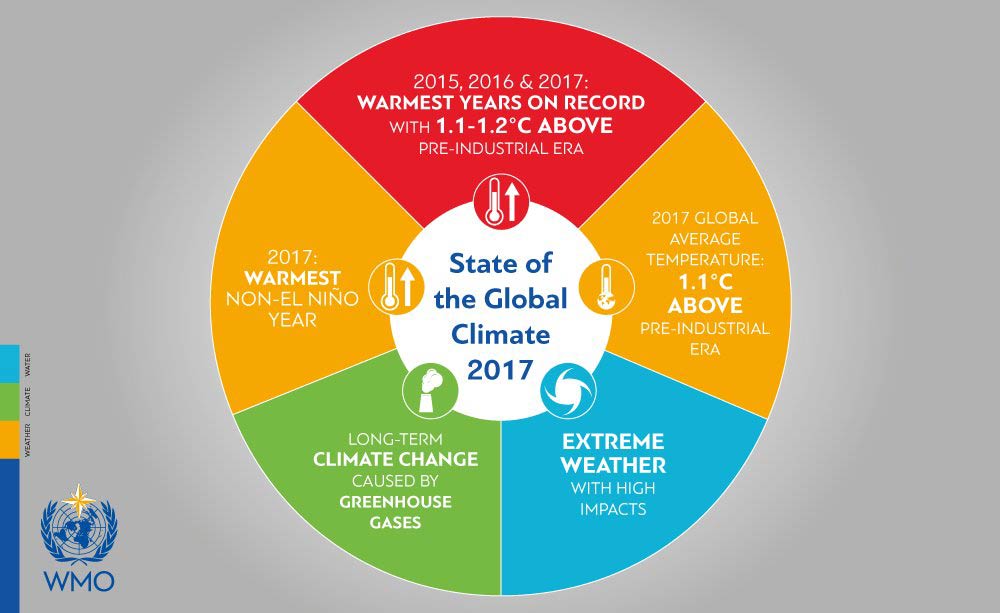
In a clear sign of continuing long-term climate change caused by increasing atmospheric concentrations of greenhouse gases, 2015, 2016 and 2017 have been confirmed as the three warmest years on record. 2016 still holds the global record, whilst 2017 was the warmest year without an El Niño, which can boost global annual temperatures.
A consolidated analysis by the World Meteorological Organization of five leading international datasets showed that the global average surface temperature in 2017 was approximately 1.1° Celsius above the pre-industrial era.
The year 2016 remains the warmest year on record (1.2°C above pre-industrial era). Global average temperatures in 2017 and 2015 were both 1.1°C above pre-industrial levels. The two years are virtually indistinguishable because the difference is less than one hundredth of a degree, which is less than the statistical margin of error.

"The long-term temperature trend is far more important than the ranking of individual years, and that trend is an upward one," said WMO Secretary-General Petteri Taalas. “Seventeen of the 18 warmest years on record have all been during this century, and the degree of warming during the past three years has been exceptional. Arctic warmth has been especially pronounced and this will have profound and long-lasting repercussions on sea levels, and on weather patterns in other parts of the world.”
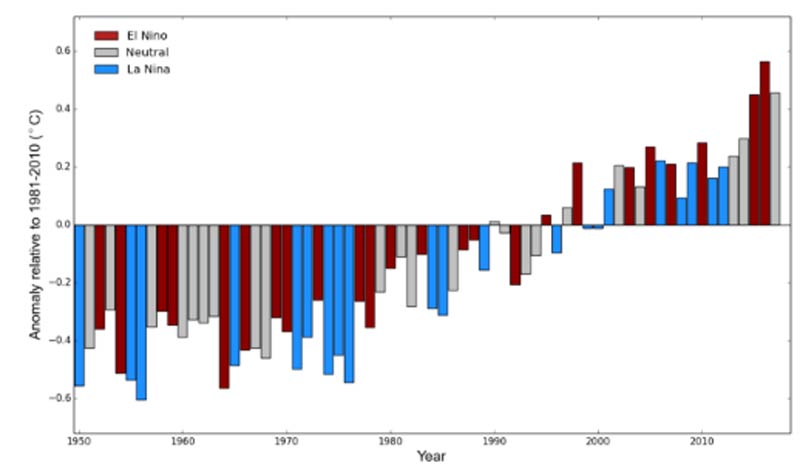
The globally averaged temperature in 2017 was about 0.46°C above the 1981-2010 long-term average (14.3°C). This 30-year baseline is used by national meteorological and hydrological services to assess the averages and variability of key climate parameters, such as temperature, precipitation and wind, which are important for climate sensitive sectors such as water management, energy, agriculture and health.
In addition to the global warming due to rising greenhouse gas levels in the atmosphere, the climate also has a naturally occurring variability due to phenomena such as El Niño, which has a warming influence, and La Niña, which has a cooling influence. The strong 2015/2016 El Niño contributed to the record temperature in 2016. By contrast, 2017 started with a very weak La Niña and also finished with a weak La Niña.

“Temperatures tell only a small part of the story. The warmth in 2017 was accompanied by extreme weather in many countries around the world. The United States of America had its most expensive year ever in terms of weather and climate disasters, whilst other countries saw their development slowed or reversed by tropical cyclones, floods and drought,” said Mr Taalas.
WMO will issue its full Statement on the State of the Climate in 2017 in March. This report will provide a comprehensive overview of temperature variability and trends, high-impact events, and long-term indicators of climate change such as increasing carbon dioxide concentrations, Arctic and Antarctic sea ice, sea level rise and ocean acidification. The final statement will include information submitted by a wide range of United Nations agencies on human, socio-economic and environmental impacts as part of a drive to provide a more comprehensive, United Nations-wide policy brief for decision makers on the interplay between weather, climate and water and the United Nations global development goals.
WMO uses datasets (based on monthly climatological data from observing sites) from the United States National Oceanic and Atmospheric Administration, NASA’s Goddard Institute for Space Studies, and the United Kingdom’s Met Office Hadley Centre and the University of East Anglia’s Climatic Research Unit in the United Kingdom.
It also uses reanalysis datasets from the European Centre for Medium Range Weather Forecasts and its Copernicus Climate Change Service, and the Japan Meteorological Agency. This method combines millions of meteorological and marine observations, including from satellites, with models to produce a complete reanalysis of the atmosphere. The combination of observations with models makes it possible to estimate temperatures at any time and in any place across the globe, even in data-sparse areas such as the polar regions.
Additional Information
The three conventional surface temperature data sets are NOAA’s NOAAGlobalTemp data set, Met Office Hadley Centre and Climatic Research Unit HadCRUT.4.6.0.0 data set and NASA GISS’s GISTEMP data set. They use measurements of air temperature over land and sea-water temperature measurements over oceans to estimate temperature anomalies around the globe. The reanalyses are the ERA-Interim of the European Centre for Medium Weather Forecasts and the JRA-55 of the Japan Meteorological Agency. Despite the very different approach, the estimates of global average temperatures produced by these reanalyses are in good agreement with the conventional surface temperature datasets
WMO now uses 1981-2010 as a baseline for computing Temperature variations at monthly, seasonal and annual time-scales. This replaces the 1961-1990 baseline used previously. The 1981-2010 period is also recommended by WMO to compute the climatological standard normal for operational climate monitoring as it is more representative of current climatic conditions. It allows a consistent reporting of information from satellite and reanalysis systems, some of which do not extend back to 1960, alongside with traditional data sets based on surface-based-observations managed by the National Meteorological and Hydrological Services of the 191 WMO Member States and territories. For global average temperatures, the 1981-2010 period is approximately 0.31±0.02°C warmer than that of 1961-1990. The change in the baselines has no influence on trend analysis.
WMO uses the period 1880-1900 as a reference period for pre-industrial conditions allowing early instrumental observations to be used for estimating pre-industrial temperature conditions.
Read the relevant WMO press release here.
Source: UNFCCC
|
Three reasons why maritime transport must act on climate change
By
For years, the transport sector has been looking at solutions to reduce its carbon footprint. A wide range of stakeholders has taken part in the public debate on transport and climate change, yet one mode has remained largely absent from the conversation: maritime transport.
Tackling emissions from the shipping industry is just as critical as it is for other modes of transport. First, international maritime transport accounts for the lion’s share of global freight transport: ships carry around 80% of the volume of all world trade and 70% of its value. In addition, although shipping is considered the most energy-efficient mode of transport, it still uses huge amounts of so-called bunker fuels, a byproduct of crude oil refining that takes a heavy toll on the environment.
Several key global players are now calling on the maritime sector to challenge the status quo and limit its climate impact. From our perspective, we see at least three major reasons that can explain why emissions from maritime transport are becoming a global priority.
1. Stormy waters – the challenge of rising emissions
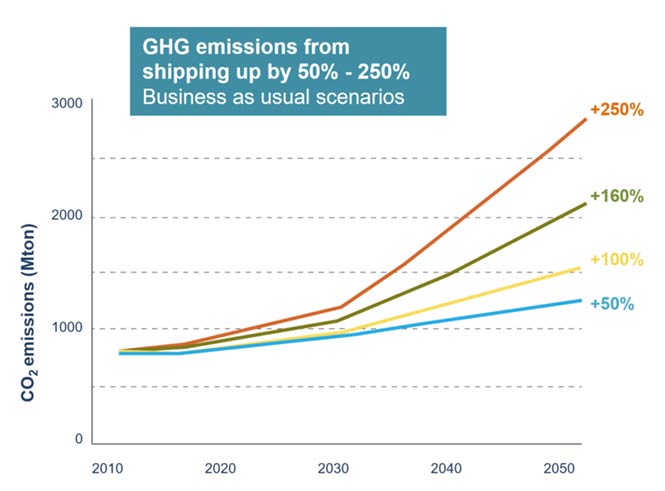
If the shipping industry was a country of its own, it would rank as the 6th largest greenhouse gas (GHG) emitter worldwide, right between Japan and Germany. While the sector’s share in global emissions is currently at 2-3%, the demand for maritime transport is soaring – and so are emissions. From 2015 to 2016 alone, the slowest year in more than a decade, the world’s fleet still grew by more than 3.5%. The result of this trend? Under a business-as-usual scenario, the International Maritime Organization (IMO) estimates that carbon emissions from shipping could increase by 50%-250%.

Evolution of GHG emissions from shipping depending on various economic growth and energy development projections. Source: Third IMO GHG Study (2014)
2. All hands on deck – the imperative of fairness
Neither international aviation nor international shipping were part of the climate change targets set under the Paris Agreement. As a consequence, these two specific industries were the only ones not included in any of the national climate action plans submitted by countries after the Paris agreement, often referred to as Nationally Determined Contributions.
Things finally started moving in 2016, when the International Civil Aviation Organization (ICAO) adopted its Carbon Offsetting and Reduction Scheme for International Aviation (CORSIA) to address carbon emissions from international flights. If the shipping sector does not follow suit quickly, its carbon emissions are forecasted to make up 10%-17% of global GHG emissions by 2050, posing a significant threat to the Paris Agreement’s goal of keeping global warming well below 2°C.
From a political standpoint, holding major emitters like the shipping sector accountable is also tremendously important to the overall success of climate action: If powerful industries are not required to do their due diligence, how can we expect poor and vulnerable countries to understand that they, too, should be taking action? And how can we expect certain transport modes to act pro-actively on climate when others are exempt from any obligations?
3. Setting sail – the window of opportunity
Pressure on the international maritime industry to take action has been increasing in recent years. For instance, in February 2017 the European Parliament voted in favor of including shipping in its EU Emissions Trading System from 2023, unless the IMO proposes comparable climate regulation on its own. Within this context, the IMO has committed to adopt an initial GHG emissions reduction strategy in April 2018, the year when the United Nations Framework Convention on Climate Change will also conduct its first global stock-taking exercise to measure progress on climate action. This will be followed by a revised IMO strategy in 2023. As the momentum builds, there is a clear window of opportunity to create a greener future for international maritime transport.
The World Bank is part of two global initiatives that have recently joined forces to support the shipping industry on this journey: the Sustainable Mobility for All and the Carbon Pricing Leadership Coalition, whose work on maritime emissions is led by the University College London Energy Institute and the Global Maritime Forum. Building an alliance of progressive maritime stakeholders to explore, discuss, and evaluate the potential of possible emissions reduction strategies is key. As Roman philosopher Seneca once said: “If one does not know to which port one is sailing, no wind is favorable.”
Source: World Bank Group
|
Connect4Climate highlights of 2017
By
Connect4Climate looks back to 2017 and invites you to check out what we have done throughout this year. It has been a fantastic year full of many significant events and activities. We are so thankful to you and to our partners for playing a pivotal role in raising awareness on climate change and in building coalitions that amplify advocacy efforts among policy-makers, the private sector, and grassroots communities.
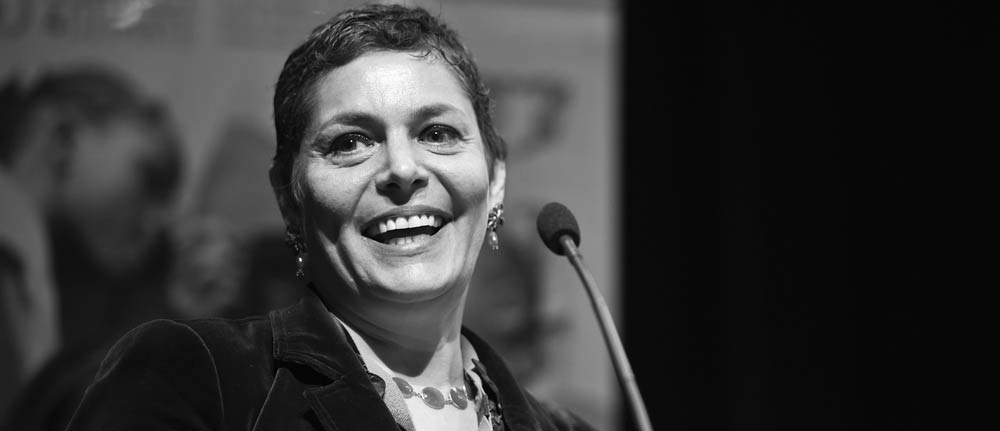
A heartfelt note for the Connect4Climate founder and soul, Lucia Grenna, who sadly passed away this year. Lucia will always be in our thoughts and actions.

World Economic Forum 2018 Annual Meeting
Timezone:
The global context has changed dramatically: geostrategic fissures have re-emerged on multiple fronts with wide-ranging political, economic and social consequences. Realpolitik is no longer just a relic of the Cold War. Economic prosperity and social cohesion are not one and the same. The global commons cannot protect or heal itself.
Hosted by the World Bank Group and supported by Italy’s Ministry of the Environment and Energy Security and Germany’s Federal Ministry for Economic Cooperation and Development, Connect4Climate (C4C) is a global partnership for a livable planet that connects, creates, and communicates to build long-lasting change for future generations.